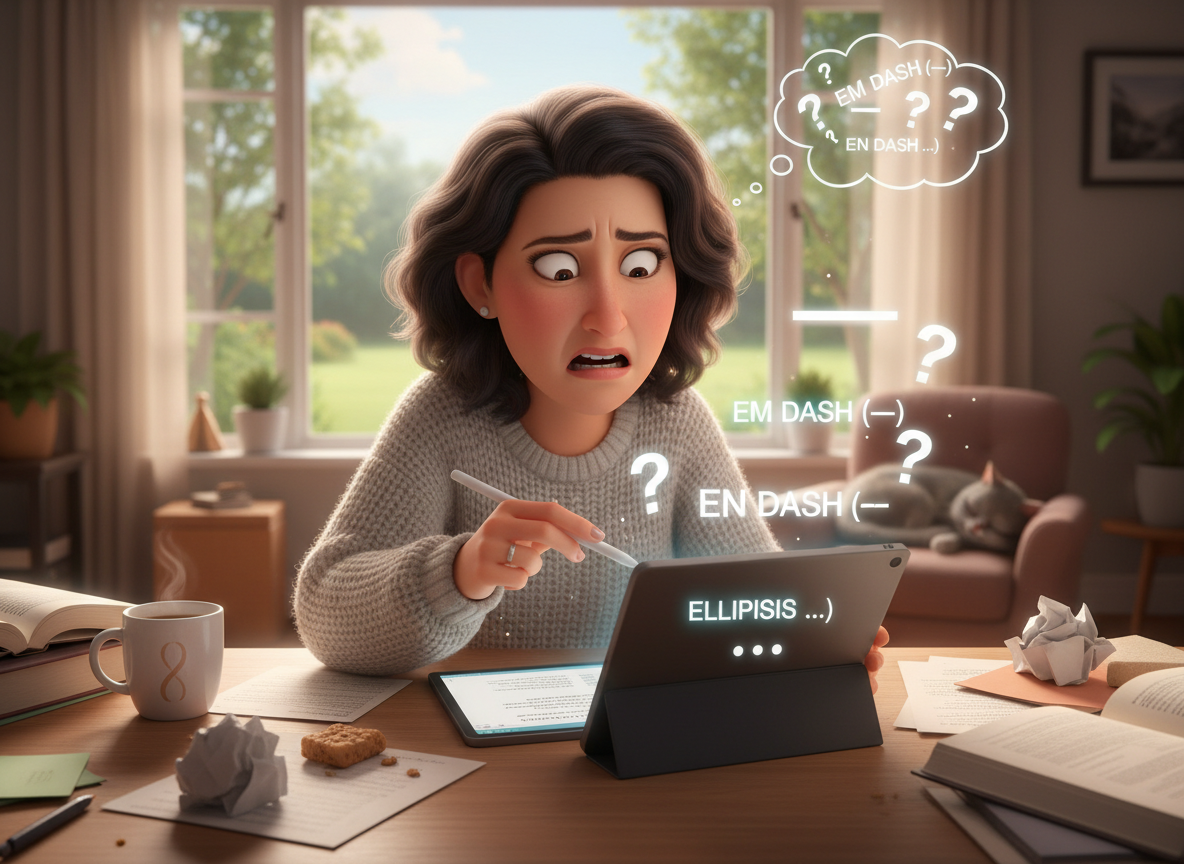
Tips from a freelance book editor: en dashes, em dashes and what goes where, when
Have you have been within ten feet of the internet since 2023? If so, somebody will have told you that if any text includes an em dash, it is a sure-fire sign that it is AI copy. But this is a myth, on a par with the Fukushima Giant Hornets, the Ratman of Southend and the Manchester Pusher.
Unfortunately, this myth concerns some writers so much, they have stopped using em and en dashes entirely. This is a shame, because the em dash and its cousin the en dash are useful punctuation marks.
However, in my work as a freelance book editor I often see dashes misused. So, here is a quick guide to em dashes, en dashes and how to use them in UK English (with a nod to US English as required).
Why do en and em dashes have such odd names?
The names originated with manual typesetting, which used fixed metal letters. The original em dash was the width of a capital letter M and the en dash was the width of the capital letter N. So, the en dash is the shorter of the two, the em dash is longer.
Using the em dash in British English
British English uses the em dash in dialogue to signify that somebody has suddenly stopped speaking – usually because they have been interrupted by another speaker or an event. So, the following uses of the em dash are correct in British English:
Victoria said, ‘I want to go—’
Alexandra, still angry, interrupted her. ‘You can’t go home. You’re due to be be crowned Queen of England at three o’clock.’
And
He began to explain: ‘I wanted to be there but—’
As the door opened, Andy saw his nemesis on the threshold. He shivered.
The em dash also has other, rather niche, uses. Some referencing formats use one or two em dashes to indicate the repetition of an author’s name. Thus:
Smith, John. 1997. The History of Britain. Madeupname Publishers Ltd., London.
—. 2001. The History of Britain II: The Sequel. Madeupname Publishers Ltd., London.
Also, I have seen a few British books (from the first half of the twentieth century, I think) where em dashes rather than quote marks indicate speech. However, this use seems to have vanished, presumably around the same time as rationing, Brylcreem and footballers called Nobby.
Using the en dash in British English
Generally speaking, UK English prefers en dashes to em dashes. As a rule of thumb, UK English uses a spaced en dash wherever Americans tend to use a closed em dash.
So, closed-up em dashes, We sat on the mat—along with the cat—until sunset, are usual in American English, but unusual in UK English. A British writer would probably use spaced en dashes: We sat on the mat – along with the cat – until sunset.
British English uses the en dash:
- Closed up to show extents. E.g. he was prime minister 1875–1885; Pages 1–35 (or, in a reference, pp. 1–35); China–Japan agreement. American English uses the en dash this way, too.
- Spaced and in pairs as parentheses. E.g. I visited London and – although I found myself on the wrong tube line twice – enjoyed it; she went outside and – because it was chilly – regretted not bringing a coat.
- As single dashes within copy. E.g. I asked him to lunch – but he was busy; the children love to eat fish – but only battered and with chips.
- To break and add information during speech. E.g. ‘I invited Mary to tea tomorrow’ – Lucy looked around to make sure nobody else was listening – ‘but I hope she doesn’t come. She’s terribly dull.’
Perhaps you noticed that I used hedging language in this section’s introduction. There’s a reason for that. Sometimes, writers have good reason to break the rules around dashes.
There are various reasons for this (style guide, aesthetic choice, etc.) In my experience, the commonest is the typeface involved. For example, in Verdana and Courier at 11 point I find the en dash looks almost identical to the hyphen. So, for clarity, I may replace the en dash with an em dash.
This freelance book oeditor sees these em- and en-dash mistakes a LOT
I see two dash-related errors over and over again. These are:
Confusing an em dash to signify interruption with parenthetical en dashes in dialogue
I see lots of things like this:
‘I won’t go to the beach tomorrow –’ Freddie’s previously impassive face became concerned, ‘–because I think it might rain and of course there is the small matter of land mines.’ WRONG!
Or this
‘I won’t go to the beach tomorrow—’ Freddie’s previously impassive face became concerned—‘because I think it might rain and of course there is the small matter of land mines.’ WRONG!
Here, Freddie is not being interrupted; the speech is interrupted by a description or added fact. So the dashes are acting as parenthetical dashes.
As a writer, you can check for this use by asking yourself, could I put brackets here? If the answer is yes, then you are dealing with parentheses and you simply put a spaced en dash where each of the brackets would go.
Like this:
‘I won’t go to the beach tomorrow’ – Freddie’s previously impassive face became concerned – ‘because I think it might rain and of course there is the small matter of land mines.’ THIS IS CORRECT!
The second error I see often is:
Using an ellipsis where an em or en dash is required, or vice versa
Ellipsis is the proper name for those three dots (…) that signify hesitation, a speaker trailing off or (when quoting) that you have omitted some text. You can also use them to create suspense. In my freelance editing experience, the first two of these are the uses that cause confusion.
For example:
‘I want to eat cake…’ said Pete.
Betty interrupted him with an anguished shout: ‘No! It will give you terrible heartburn.’ WRONG!
Here, the ellipsis ought to be a closed-up em dash. Pete is not trailing off or hesitating, he is being interrupted and brought to a sudden halt.
‘I want to eat cake—’ said Pete.
Betty interrupted him with an anguished shout: ‘No! It will give you terrible heartburn.’ THIS IS CORRECT!
I have also read (not edited) an example of American English where all of the ellipses that signify hesitation were replaced with em dashes. This is incorrect in UK English and I strongly suspect that most American publications would frown upon it, too. You might get away with a couple of uses to signify very extended pauses but the whole lot? Nah.
My suggestion? Put the ellipses where the ellipses should go and put the dashes where the dashes should go. Even if other people are unsure, I maintain the two are not equivalent.
So there you go; my quick guide to using dashes. If you have any comments, or further questions about my work as a freelance editor, just drop me a line.
Comments are closed